Monday, July 23, 2012

Taking on Tech

The International AIDS Conference has come to Washington, and I can see delegates getting to work throughout the city. So it is a bit strange at this moment to be diving into a new subject, as the Post's national technology reporter. Just got back from a quick visit to Europe, and the first of my stories from the trip is on the front page of the paper today. It's about how European regulators are pushing hard on the big American technology companies, Google foremost among them. Please take a look. More to come from this trip and others. I'll keep you posted.

Monday, February 27, 2012

Fresh Air on Tinderbox

My interview on Fresh Air was broadcast today. I'd love for you to listen to it. Here's the link.
The interviewer, Dave Davies, was quite thorough in going through all of Tinderbox's major themes. I'd love to hear your impressions of it. Please leave a comment below.

Wednesday, February 22, 2012

New Web site for Tinderbox

Hello everybody. My co-author and I just had a cool web site built. Please check it out for information on the book and (come March 1) excerpts as well, at http://www.tinderboxbook.com/

Tuesday, January 31, 2012

Tinderbox is Coming March 5


At long last, the book that I have co-authored with epidemiologist Daniel Halperin is coming out on March 5. Tinderbox: How the West Sparked the AIDS Epidemic and How the World Can Finally Overcome It, published by The Penguin Press, is printed and on its way to book stores. Watch this space for details...

Saturday, October 31, 2009

Dugger Nails It


I've been a bad, bad blogger since I took over the job as Education Editor at The Washington Post a few months ago. That makes feel me a bit sheepish about trying to pick up my game now. But Celia Dugger's excellent piece in the New York Times yesterday inspired me to dive back in. Here it is.
This picks up on themes my co-author Daniel Halperin has been pushing for years, including in a Times op-ed piece in 2008 pointing out the vast and growing inequities in global health assistance by big donors.
All of us who care passionately about the AIDS epidemic have to grapple with these issues. If the goal is letting people live longer, better lives, how best can we array the available resources while also pushing for more resources overall?

Tuesday, June 30, 2009

Testing the HIV Testing Mantra


Early in my Johannesburg years, I used to have regular coffee chats with Dr. Francois Venter, president of the Southern African HIV Clinicians Society. Over cappuccinos (we both had serious caffeine addictions), we'd talk about how to save the world from AIDS. More often than not, we'd scheme about how to get everybody tested for HIV. It seemed like a natural triple-word-score of AIDS progress. If everybody knew who was infected, stigma would go down. The sick would seek treatment. And everybody would be more careful.
.
Well, seems we were wrong, at least about that last part.
.
Dr. Venter and I were hardly the only ones mulling those issues at the time. The picture above shows Randall Tobias, the former Bush Administration Global AIDS Czar (before his fall from grace) getting an AIDS test to publicize the importance of the issue. Former President Clinton has talked up testing endlessly. So has Richard Holbrooke, and many, many others.
.
What we all missed was that while testing does indeed help people seek treatment, and likely eases stigma because the extent of HIV infection is clearer to all, there's little meaningful evidence that people who get tested act safer in the long run. In fact, the opposite may happen.
.
Several studies, both in Africa and among the U.S. and U.K. gay communities, suggest that measures of safe behavior often deteriorate for those who test negative for HIV. Not knowing your status, it seems, inhibits certain kinds of reckless behavior, such as multiple partners, visits to prostitutes and sex without condoms. Knowing for sure that you are NOT infected, meanwhile, can do the opposite. It can validate past behavior, including risky behavior. It's like a smoker finding out they don't have lung cancer... yet.
.
The good Dr. Venter gently broached this subject in a recent conference in South Africa, suggesting that the testing mantra is overdrawn. Kudos. The groupthink on this subject has gone on far too long. Kudos also to my co-author Daniel Halperin, who pointed out to me the limits of HIV testing a several years ago, allowing me to get off the bandwagon earlier than most. Here is his 2007 op-ed piece in the Washington Post about this.
.
Nobody, of course, is suggesting that getting tested for HIV is a bad thing. It's a good thing. But let's not confuse something that is good for the individual (who may now seek treatment) with something that has the power to slow the spread of AIDS on a broad, society-wide level. The list of those things, sadly, is rather short.

Tuesday, June 9, 2009

Craig Has Landed Back at the Post....


Regular readers of this blog (and my Tweets and Facebook updates) may have noticed that I vanished from cyberspace about three weeks ago. The reason was a fateful call from The Washington Post that has led to my becoming Education Editor, after a decade as a reporter there. No one is more surprised--or thrilled, or surprised that I'm thrilled--than I am. But the shift has been so abrupt that some explanation may be in order.

First, I'm still working on my book project with Harvard AIDS researcher Daniel Halperin, and given that I don't have to show up at the Post newsroom until my book leave ends in early September, we have three months to complete at least an initial draft of the manuscript. Second, my interest in all things about AIDS and Africa is undiminished. I still obsess about Zimbabwe, South Africa, Nigeria, and whether all the billions being poured into the AIDS War are being used well. This blog will continue to discuss those issues.

But my unexpected discussions with the Post's new Local Editor, Emilio Garcia-Ruiz, awakened something in me that I was trying to ignore: American newspaper journalism is in grave trouble, and I was on the sidelines in the battle to save it. I watched the Tribune Company hack two-thirds of the muscle out of the newsroom of The Baltimore Sun, my father's longtime professional home, and lay off my extraordinarily talented brother, Scott, from the Los Angeles Times (despite a run of good evaluations). So the personal stakes were certainly clear to me.

Yet even more I worried that the loss of our newspapers meant the loss of a shared narrative about our nation. The best papers are the daily diaries of their communities, and having lived and traveled in parts of Africa that lacked strong newspapers, I could see what happened when citizens and their leaders didn't agree on even the most basic elements of what was happening in their societies.

All papers, even the best ones like the Post, surely have failings but for decades they have been places where we meet, we talk, we chew over difficult issues, we exult in human achievement and lament human failing. Maybe cyberspace is becoming that, but from here it seems to created ever-more fractured conversations as it empowers new voices, diminishes others, and spins continually outward into new terrain. The center does not hold. Even the idea of the center--a place where straight-up news gathering is regarded as something akin to a calling--is feeling more quaint and antiquated by the day.

Offered the chance to rejoin a newsroom that's trying to save something so dear, I leapt at it with my usual manic fervor. That's why I've been out of touch for awhile. As one of my new editor colleagues said to me: "If we're going to go down, we might as well go down fighting."

Hell yeah!

That doesn't mean that the Post is in imminent peril. By most measures, the Post is the healthiest of the major American newspapers. Yet there's no ignoring that if we don't figure out how to make real money on the web, all newspapers are doomed.

I did, in applying for this job, gently mention to my new boss Emilio that I had virtually no background in either editing or education. But I also once knew nothing about Virginia politics, or D.C. politics, or AIDS, or any number of African nations. And I did already have a sense that schools and universities are so central to our societies that they should be a continuous source of great journalism, even if they have not always been so in the past.

As I began to assess my new team of reporters, it quickly became clear that the Post had a deep stable of talent ready to push harder and deeper into the subjects our readers care about. Probably the most difficult challenge we face will be mastering the new journalistic forms that the the web makes possible and, for those news organizations that survive this transition, ultimately demands of us.

So that's what's happening. I'm becoming an editor after 16 years as a reporter, foreign correspondent and (fingers crossed) an author. I can't think of anything right now that sounds more fun, or more important.

Saturday, May 9, 2009

The Sounds of Spring

Over the last week my family and I have made our annual warm-weather pilgrimage up the hill, to our off-the-grid cabin in the hills of Otsego County, New York, up above Cooperstown. I am writing this on a laptop charged off our car battery, using an Internet signal coming invisibly from a cell tower miles away. We have not one but two iPods, and as of this weekend a battery-powered DVD player. This may not be exactly what Thoreau had in mind...

All the same, life in the woods in springtime offers revelations I can't imagine arriving any other way. There's nothing quite like venturing out with my children Cecilia, Andrew and Natalie to check their apple tree saplings as they grow buds, then leaves, then tiny red blossoms, still coiled tightly today but ready to burst forth. Yesterday my children caught their first neon-orange newt of the New Year, and then spent the next hour catching tiny flies to feed to it.

Yet it's the sounds that startle me with their springtime lust for life. There's the astonishingly loud, echoing pounding of the woodpeckers hunting for breakfast in the bark of old trees. This morning I heard the deep, rhythmic flapping of geese flying low over the metal roof of our cabin. And of course, this being near Cooperstown, we have the THWAPPP! of baseballs and softballs hitting leather gloves, or clinking off aluminum bats, as my two older children acquire a growing love for our National Pastime.

But it's at night, when human sounds quiet, when I feel totally at one with spring. There are owls hooting, nocturnal critters scurrying and the occasional coyote baying at the moon. And then, if I stand still, I hear a slow but sharp sound like the crinkling of paper, or a small waterfall maybe. It is tiny new plants, new life fashioned into green spears of fresh growth, forcing their way through last year's old dead leaves. Sometimes, in the light of morning, we can see the shoots of this new life stabbed right through the old.

Wednesday, May 6, 2009

The Globe Lives On...


It's nice to see The New York Times has decided not to shut down The Boston Globe after reaching deal with the unions. I guess that's good news. Yippee. But I can't shake the feeling that we're in a whole new phase of the destruction of the newspaper industry when we are cheering that one of the nation's oldest and best papers, based in the hub of an amazingly vibrant cultural and economic region, has earned a reprieve from the guillotine. We all know the blade remains sharp, and ready to drop on any one of us next week, next month, next year.

If the economy really recovers perhaps we can begin to understand how much of the recent wave of layoffs and newspaper closures is cyclical and how much is structural. Obviously it has been an evil combination of both until now. But I think we all know that the long-term prognosis is dire so long as print revenue keeps plummeting and web revenue stays so thin.

And I'm getting sick of the lazy assumption that we all were simply too stupid to adapt to the tidal wave as it loomed on the horizon. Just about the smartest journalist I have ever known-- Steve Coll, he of two Pulitzers, the New America Foundation and New Yorker staff writerhood--spent the late '90s and early '00s trying to see the future during his previous incarnation as the managing editor of The Washington Post. If he couldn't figure it out before it arrived, I'm not sure any human could have.

So what's left to do? I wish I knew. I hate the idea of walling off the news business behind the money of private foundations, no matter how well-intentioned. All money has strings, and in a way pure profit motive--money freely given in exchange for a service--is actually the most straightforward ethically. Is there a way to make money on the web? Can this idea about charging tiny amounts for each story work? It all depends on how much the public decides they value what we do. In that narrow way, maybe the scare over the Globe's possible death has been a wake-up call to us all. If our nation values its newspapers, they are going to have to decide they are worth saving, which means somehow paying for them again.


Monday, May 4, 2009

As Newspapers Wither, So Does Journalistic Innocence


For years, the surest way to get me to lose my reporter's cool was to accuse a newspaper (especially one I was writing for) of printing a story "just to sell papers." This irritated me not only because I'm a journalist, the son of a journalist and the brother of a journalist but because the people who ran newspapers were, so far as I could tell, pretty bad at trying to sell them. When was the last time you saw a story on Britney Spears or some new magical wrinkle cream on the front of The New York Times or The Washington Post, or even in their small-town equivalents? The hundreds of people I know in the newspaper industry did the job because it mattered, or they (we) thought it did.

We always delighted in challenging power, to use the old catch-phrase, comforting the afflicted and afflicting the comfortable. However much that may have satisfied the soul, it was not exactly a prescription for printing money. By and large, we simply were not populists. Newspaper publishers seemed to know this, and instead relied on non-journalists to make money, which was not terribly hard in the days when newspapers were the only broad-based source of real estate ads, classifieds and sports scores in any given city. The news, from a business point of view, probably always came second, and to the extent journalists were crucial to selling newspapers, it was the slow accumulation of credibility that was our most important contribution, not a single sensational story. But while the much-mocked "bean counters" made money, we were free to spend it by pursuing what we imagined were social goods: telling the truth, no matter how uncomfortable it often made the powers that be, or even our own readers. We were insulated. We were naive. We were innocent.

The wave of newspaper closings and layoffs has, I fear, begun to change that forever. The New York Times, of all entities, is threatening to close The Boston Globe, which was for decades one of the best around, and probably THE best for its market size. Meanwhile The Baltimore Sun, where my father worked for parts of four decades, and where both my brother and I spent time on our way to bigger places, has been gutted beyond recognition. Check out this terribly depressing account by my old Sun friend Dave Ettlin for the gory details. If I've got this right, The Sun's newsgathering power has declined by more than half from wave after wave of cuts. After you make cop calls or keep up with the Orioles and Ravens, and maybe attend a City Council meeting, what exactly do you have the horses to do? Having spent years overseas, in places that were short on serious, reliable sources of news, I can tell you that their absence undermined serious debate about just about everything.

So if we ever recover as an industry, I can't imagine we'll recover that essential spirit of reckless disregard for the economics of selling news. We all now know, in our guts, what it means when we don't sell papers. And while we've lost our innocence on this, there's little sign this obliviousness to the bottom line is built into the ethic of the webosphere. (About halfway down this David Carr column in the Times, see an appalling account of attempted news profiteering by a blogger at the Huffington Post.) Every click of a reader’s mouse generates data on what’s a hot topic that day. Simply having all that information operates as a kind of vast bio-feedback mechanism that makes it impossible to ignore the preferences of readers, for better or worse. No reader survey ever could come close to what web diagnostic tools tell newspaper editors every day about what might make their product sell better.

That doesn't mean you'll see stories about Britney or miracle skin cream any time soon on the front page of the Post or the Times. But the new world of free, easy media access has totally rearranged the incentives. A steady accumulation of credibility--of being right, or as close as possible, day after day after day--is worth less and less. The essential stodginess of newspapers, perhaps of serious news itself, seems to be a fatal flaw in an age of constant, rapid-fire sensation, stimulation, entertainment. The next time I hear somebody say, "They're just trying to sell newspapers," I will reply: "I wish."


Monday, April 20, 2009

The Fight for Sarah Obama's Soul


I'm no partisan. Heck I don't even vote. But I can tell you that traveling in Kenya over the past couple of weeks, it has been a delight to see how delighted Kenyans are about Barack Obama. Out in Luoland in Western Kenya, there are signs pointing to his family's ancestral home. After interviewing a Luo elder, one of his wives who works as a seamstress brought me some Obama cloth and shirts featuring his face on a traditional African pattern. At a hip party in Nairobi yesterday, where the menu include plenty of Smirnoff vodka and a bit of goat-head soup, one of the guests was wearing an Obama t-shirt that featured a solemn image of the president and the words "Making history." As I travel around, faces light up whenever I mention I'm an American.

I never sensed much anti-Americanism during my years kicking around the continent for the Washington Post, but I often got the sense that Africans didn't regard the U.S. government as consistently on their side. The main exception was in the petro-state of Nigeria, where George W. Bush's Texas oilman style went down well.

Obama's election has changed the emotional/political chemisty to an amazing extent. The Kenyan papers are trying to outdo each other in trying to get the scoop on a possible Obama presidential visit. And the fascination with all things Obama extends even to the soul of his sort-of grandmother, Sarah Hussein Obama, a Muslim who almost, but not quite, converted to Christianity over the weekend.

Sarah Obama is the third wife of Obama's grandfather, making her, in the family tree of the Luo ethnic group, a "grandmother," even if not Obama's exact, direct grandmother (who was, instead, the second wife of his grandfather. Got that?) Being a dutiful son of Kenya, President Obama calls Sarah Obama "Granny Sarah," as he should. (She is second from the right, bottom row, in the picture, looking resplendent in this image of Barack Obama's Kenyan family.)

The story, as told by Kenya's Nation newspaper, is that the Seventh Day Adentist church, which has sunk deep roots in Luoland over a century of energetic missionary work, managed to convince Sarah Obama to renounce Islam in favor of Jesus Christ. Her Kenyan relatives, however, stepped in before the baptism could take place. The Council of Imams and Preachers of Kenya endorsed her family's blocking maneuver in a statement yesterday: “Mama Sarah should not be forced by anybody to join Christianity since she is a Muslim. Conversion must take place in a voluntary manner,” a group spokesman said.

Seems reasonable enough to me, but I have a feeling this saga may not yet be over...

Sunday, April 19, 2009

Canadians vs Somali Pirates: Who's Winning?


Hard to tell really. If you watch this video that a Canadian Navy public affairs team posted after a pirate encounter couple of weeks ago, you'll see Canadians with big guns and silly hats bravely capture Somali pirates, disarm them and make them walk the plank.


No, no, sorry. They don't walk the plank. They go free. The Canadians don't even confiscate the skiffs the pirates are using to terrorize international shipping. The Canadian Navy did much the same thing after an attack today.


No doubt there is some good reason for all this pirate coddling. But it's hard to fathom what it might be. Even Johnny Depp got spent a little time in jail when British naval authorities caught up with him at various places in the Caribbean, or was that Disney World? The Somalis, on the other hand, are free to keep it up until, apparently, they make the mistake of taking a handsome American captain hostage. All I can say is "Argh!"

Friday, April 10, 2009

A Must-Read Book: "Tulia"


One of the most-satisfying things about writing a book is that you have to read a lot of books, and think about them, along the way. I'm just now finishing the best book I've read in a long time: "Tulia: Race, Cocaine and Corruption in a Small Texas Town."
No doubt the better-read followers of this blog already have worked their way through this masterpiece, which was both a New York Times Notable Book of the Year and winner of the J. Anthony Lucas Book Prize. But I was overseas when it first came out in 2005 and had missed it. I can only say, "Wow!"
A book editor friend of mine recommended this, even though it has nothing to do with my normal preoccupations with AIDS or Africa. But it dives right to the heart of America's terrible racial history and its punishing present-day legacy in so much of the United States.
Author Nate Blakeslee chronicles the arrests of more than 40 supposed drug dealers, which amounted to a massive swath of the marginalized black community of a town of just 5,000 people. The evidence from an undercover narcotics officer was unusually thin and uncorroborated, but that didn't keep West Texas juries from doling out dozens--in one case, hundreds!--of years to these defendants.
Of course it all falls apart as the undercover cop turns out to be shady himself, and apparently a habitual liar. The most chilling part of the book, of course, is that most cases in our so-called drug war don't get anywhere near this much publicity, or scrutiny. It took a high-powered team of attorneys, and the pardon of an embarrassed governor, to eventually undo these blatant injustices. But how many injustices pass without notice beyond the routine reach of public scrutiny and good defense attorneys?

Thursday, April 9, 2009

The Uganda Miracle That Was


The world has hailed Uganda's success on AIDS for so long that few have noticed that the glory days happened long, long ago. But Ugandans know. A chilling report on the epidemiology in Uganda, by Fred Wabwire-Mangen, stated bluntly last year (Here's a Powerpoint Version)that the declines in new HIV infections are over.

" 1. The previously heralded precipitous decline in HIV prevalence and incidence in Uganda stopped in 2002. HIV prevalence and incidence are now on the increase in Uganda

2. HIV-related sexual behaviours have deteriorated especially for men. There is evidence of: a rise in the number of life-time sexual partners and concurrent sexual partnerships; an increase in sex with non-regular partners, and a decline in condom use both for any sex and in the context of higher-risk sex."

Yikes!
A trio of Uganda AIDS experts tried to ring the alarm bells with articles in major Ugandan papers in January (here's a link to a copy of them). But I've sensed little energy around the issue on my visit here to Kampala, the national capital. Ugandans speak often of the AIDS epidemic in the past tense, and AIDS experts here are convinced that widely available treatment has taken the energy out of prevention campaigns. Now there's a dilemma to ponder: Is there any way to have good treatment and aggressive prevention programs at the same time?

Tuesday, April 7, 2009

The Rorschach Test


I'm on my way to Uganda to do some more reporting on the astonishing, and generally misunderstood, story of how this country emerged from devastating civil war in the mid-1980s to craft the most effective AIDS response in African history. It's a subject I've tackled before for The Washington Post. But for the purposes of book writing, I need to dig deeper, as well as feel the African sun on my skin and again marvel at the world's ugliest birds, which fly around Kampala, the capital.
Cynics often describe Uganda as Rorschach Test of AIDS: People see what they want to see. Some attribute the steep drop in new infection that began in 1989 (and ended in 1994) to condoms, others to abstinence. Some say good political leadership was the key, or maybe multi-sectoral approaches. Even Death, sometimes called the "D" of "ABC" prevention efforts, gets credit for the steep drop in AIDS rates.
I don't think much of this has held up to serious scrutiny in the years since scientists Rand Stoneburner and Daniel Low-Beer published their groundbreaking study in Science magazine in 2004. It showed conclusively that the drop in new infections tracked with major shifts in sexual behavior, away from multiple sex partners, casual sex and prostitution. Political, religious and cultural voices spoke together in those years, urging people to be more monogamous, or at least faithful to their spouses if polygamous. The resulting changes saved more than one million lives. And it all happened, and pretty much ended, before the wave of condom promotion that began in the mid-1990s and the abstinence programs that began a few years after that.
In any case, I'm hoping to have more to say in a few days. But my hunch is that Uganda's story is the opposite of a Rorschach Test. It was a moment of remarkable clarity, now lost and gone away. Those stupid blurry ink splotches, however, seem like they will be with us forever.

Thursday, April 2, 2009

The Chinese: Africa's Salvation, or Doom?


This kind of simplistic question dominated about a decade worth of news coverage of rising Chinese influence in Africa. Both answers, of course, are wrong. Chinese incursions, both economic and political, upended the old order but the influence was neither uniformly benign, nor entirely malign. That ship carrying guns and bullets to Zimbabwe's embattled government certainly was a low point, but Chinese money and skill also built plenty of road, port and rail projects. Plus many Africans I interviewed were pleased with the straightforwardness of their dealings with Chinese companies. They were about profit, not about "saving" Africa.... as the West has been trying to do with varying degrees of success for nearly two centuries.
One correspondent who consistently avoided the salvation-vs.-doom trap is Lydia Polgreen, the excellent West Africa correspondent for the New York Times. Her story this week out of Guinea reminds us the Chinese-Africa relationship, like all relationships, is complex.
It also reminds us, as the Post's Karin Brulliard did last week with her dispatch from Zambia, that when things in the world go wrong, Africans generally pay the price--whether or not they had any role in causing the problem.

Wednesday, April 1, 2009

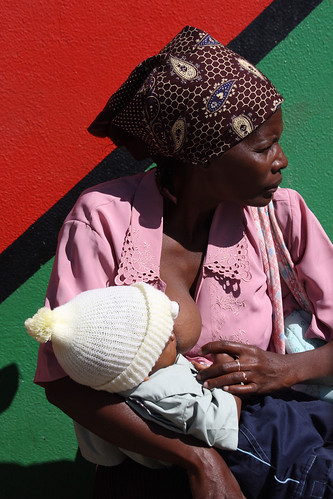
Should African Mothers With HIV Breastfeed?


Amid all the talk about the Pope and condoms the last few weeks, many people overlooked another intriguing development about AIDS in Africa. Health authorities in Mozambique are urging women with HIV to breastfeed their babies. Like many issues in the AIDS world, the logic is totally counter-intuitive. But given the other threats babies face in the poorest parts of Africa, the risk of getting HIV from breast milk is small compared to the risk that babies will die of other maladies that breastfeeding helps prevent.

The most obvious is the danger posed by infant formula itself in places that lack reliable sources of clean water or sterile feeding equipment. A couple of years ago, I wrote a story for The Washington Post about floods in Botswana that caused widespread water contamination, which led to the deaths of more than 500 babies and young children. In some places, two or three died in a single village. What an American team of investigators found was that well-intentioned efforts to provide infant formula to women with HIV had led to widespread abandonment of breastfeeding, even among women who didn't have HIV. A huge percentage of the children and babies who died during the floods were not breastfed. The push for the formula feeding came largely from Western medical authorities working at UNICEF, though the agency later reconsidered as evidence about the dangers of formula mounted.

Breast milk is not only inherently free of the kinds of contaminants that get into drinking water, it also has nearly perfect nutrition for a baby and antibodies that protect a child against all manner of disease. So while women with HIV who have access to reliably clean water, as in the case of some modern cities such as Johannesburg, should use formula, others mothers should abandon breastfeeding only with great caution.

In places where clean water is not available every single day, the best solution for mothers with HIV probably is breastfeeding ONLY for the first six months. Then breastfeeding should stop entirely and be replaced by other foods. Mixing breast milk that contains HIV with other food sources dramatically raises the risk of the HIV infection taking hold in the baby. The reason is that digesting the other food causes tiny intestinal ulcers that HIV can penetrate fairly easily. So let's hear it for the Mozambicans for applying the best available science to a difficult situation.

Friday, March 27, 2009

Farewell McGreal, Guardian's Man in Africa


For 20 years, there has been no journalist in Africa quite like Chris McGreal, the bulldog of Britain's Guardian newspaper foreign corps. Chris was everywhere, or had been everywhere, when Nelson Mandela cast his first ballot in 1994, when Hutus were slaughtering Tutsis in Rwanda, when Zimbabwe's long descent into hell picked up speed. Chris hustled. He was brave. He was tough. He took no shit. And, to top it off, he wrote pretty damn well too, better than most of us dared.
Check out his swansong today, whose only weakness is the inevitable, hackneyed headline "Out of Africa." Egad. I'm sure it's the fault of some editor somewhere. In any case, at a time when many great foreign correspondents have gone home, been laid off, or simply moved on to other parts of the world, I mourn Chris's move to the Washington bureau for the Guardian. Our understanding of our still-new president no doubt will be enriched, but our grasp of Africa certainly will suffer.

Wednesday, March 25, 2009

Global Recession Hits Africa


Terrific story on the front of today's Washington Post by my colleague Karin Brulliard, who took over as Johannesburg bureau chief after I left. I particularly like the lede, colorful, but sharp and to the point:

LUANSHYA, Zambia -- The global economic meltdown swept into this company town and took down the copper mine in January. It left in its wake a crisis measured in unsold tomatoes at the market, empty stomachs and desperate people lined up outside Chishimba Kambwili's pink house each morning.

Tuesday, March 24, 2009

Ah, Zimbabwe


There was a nice piece in the L.A. Times over the weekend comparing trying to report in Zimbabwe with similar challenges in war-torn Chechnya. Well-worth the read, with many nice touches by correspondent Robyn Dixon.
Wish I could write like this:

"The road to Gweru beckons, like a painting: a ribbon of pocked gray tar, flanked by jagged red gravel lines and wide green stripes of bush daubed on thick and wild. Nimble gray monkeys leap from red to green as you pass."

I fear it's too late for me to learn. Too much TV, not enough poetry, in my youth.